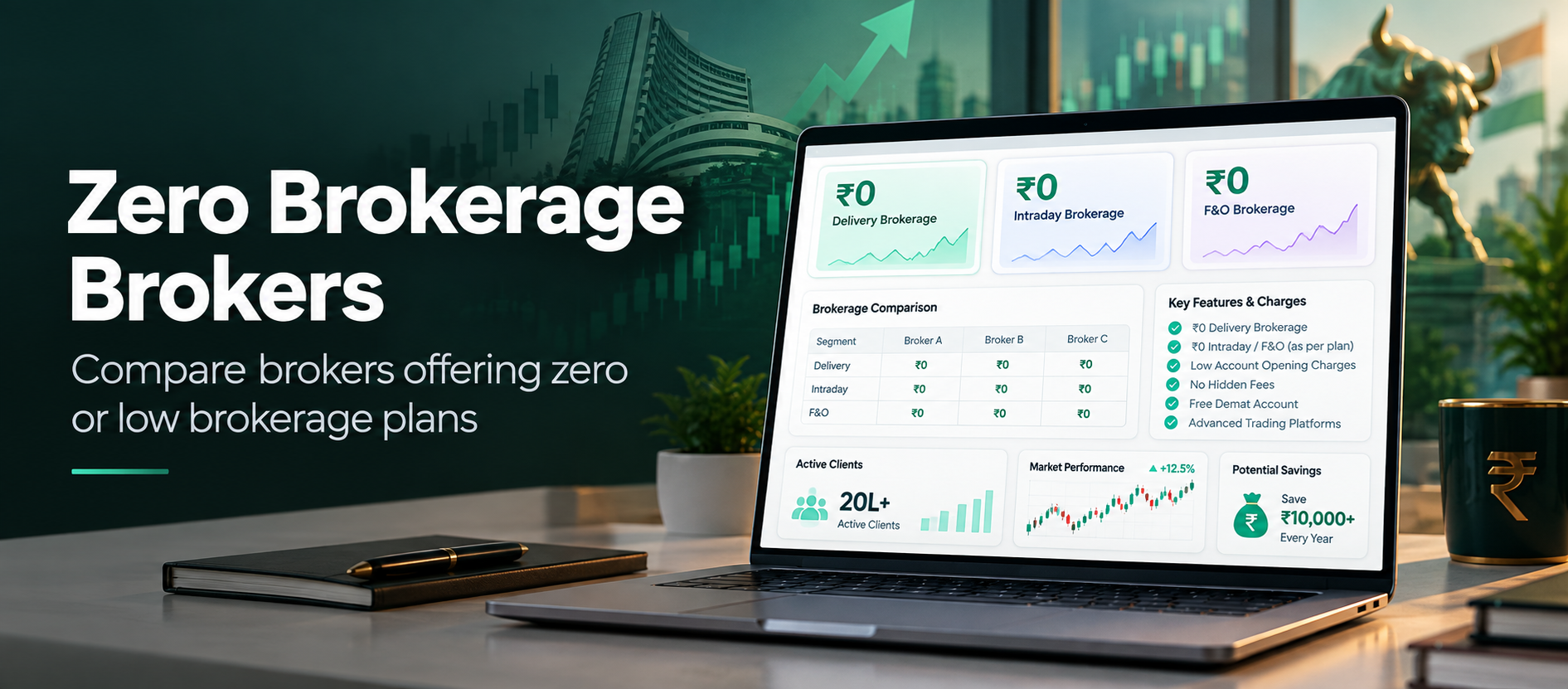
Zero brokerage brokers are stock brokers that offer ₹0 brokerage on selected investment or trading segments. In India, the term “zero brokerage” is most commonly used for equity delivery, ETFs, IPOs or direct mutual fund investments.
However, zero brokerage does not always mean the entire account is free. A broker may offer ₹0 brokerage on delivery trades but charge brokerage for intraday, futures, options, MTF or other services. Users should also check DP charges, exchange transaction charges, SEBI charges, GST, STT, stamp duty, account maintenance charges and other applicable fees before opening an account.
What Is Zero Brokerage?
Zero brokerage means the broker does not charge brokerage on a specific type of transaction.
For example, Zerodha officially lists ₹0 brokerage for equity delivery investments and direct mutual fund investments, while intraday and F&O trades are charged separately as per its pricing page. Dhan also lists ₹0 brokerage for equity delivery, ETFs, IPOs and mutual funds, while intraday, MTF and F&O have separate charges.
This is why users should always check the segment-wise pricing instead of assuming that every trade is free.
Is Zero Brokerage Really Free?
Zero brokerage can reduce the cost of investing, but it does not remove all charges.
Even when brokerage is ₹0, users may still pay statutory and operational charges such as STT, GST, exchange transaction charges, SEBI turnover charges, stamp duty and DP charges.
For example, delivery sell transactions may attract DP charges depending on the broker. This means the real cost of a trade should be checked using the broker’s complete charges page or brokerage calculator.
Brokers Commonly Compared for Zero or Low Brokerage
Here are some popular brokers that users often compare for zero or low brokerage plans:
| Broker | Current pricing position |
|---|---|
| Zerodha | ₹0 brokerage on equity delivery and direct mutual funds; intraday and F&O are charged separately. |
| Dhan | ₹0 brokerage on equity delivery, ETFs, IPOs and mutual funds; intraday, MTF and F&O are charged separately. |
| Groww | Not fully zero brokerage for stocks; official pricing shows equity brokerage as ₹20 or 0.1% per executed order, whichever is lower, with minimum ₹5. |
| Upstox | Not fully zero brokerage; official pricing shows brokerage on equity delivery, intraday and F&O. |
| m.Stock | Low flat brokerage model in the current pricing shown; official pricing displays ₹10 per order across equity delivery, intraday, futures and options, along with ₹0 account opening, AMC, platform charges and call & trade service. |
| 5paisa | Often compared for low-cost trading plans; users should verify the latest plan directly from the official pricing page. |
| FYERS | Often compared by active traders for platform features and pricing; users should verify the latest charges directly from the official website. |
| Angel One | Popular full-service/digital broker; users should check current brokerage and offers directly before opening an account. |
| HDFC SKY | Popular broker from the HDFC group; users should check current plan, brokerage and account charges directly from the official website. |
Zero Brokerage for Equity Delivery
Equity delivery is the most common segment where brokers offer zero brokerage.
This is useful for long-term investors who buy shares and hold them for weeks, months or years. If you mainly invest in stocks for long-term holding, ₹0 delivery brokerage can reduce your cost over time.
At the time of writing, Zerodha lists equity delivery investments at ₹0 brokerage, and Dhan lists equity delivery, ETFs, IPOs and mutual funds as free from brokerage. Users should still check DP charges, statutory charges and updated pricing before placing trades.
Zero Brokerage for Intraday Trading
Zero brokerage for intraday trading is less common than zero brokerage for delivery investing.
Most brokers charge either a flat fee per executed order or a percentage of trade value for intraday trades. For example, Zerodha lists intraday brokerage as 0.03% or ₹20 per executed order, whichever is lower. Dhan also lists intraday brokerage as ₹20 or 0.03% of trade value per executed order, whichever is lower.
Active traders should compare platform speed, charting tools, order execution, reliability and total charges, not only brokerage.
Zero Brokerage for Futures and Options
Futures and options are usually not zero brokerage for most brokers.
Many brokers charge a flat fee per executed order for F&O trades. For example, Zerodha lists flat ₹20 brokerage on options trades, while Dhan lists ₹20 per executed order for equity and commodity F&O.
F&O traders should compare brokerage, exchange charges, margin facility, option chain tools, charting quality, order types and platform stability before selecting a broker.
Charges to Check Before Choosing a Broker
Before selecting a zero or low brokerage broker, check the full cost structure.
Important charges include:
- Brokerage charges
- Account opening charges
- Annual maintenance charges
- DP charges
- STT
- GST
- Exchange transaction charges
- SEBI charges
- Stamp duty
- Call and trade charges
- Auto square-off charges
- Pledge and unpledge charges
- Payment gateway charges
- MTF interest charges
- API or premium tool charges
A broker may advertise ₹0 brokerage but still have other costs that affect your final trading expense.
Benefits of Zero Brokerage Brokers
Zero brokerage brokers can be useful for long-term investors, beginners and small-ticket investors.
They help reduce the cost of regular investing, especially when the user mainly buys shares for long-term holding. Zero brokerage can also make it easier for new investors to start without worrying about high transaction costs.
Limitations of Zero Brokerage Brokers
Zero brokerage does not automatically mean the broker is the best choice.
Some brokers may have limited research, limited advisory support, fewer offline branches or fewer premium services. Others may charge separately for advanced tools, APIs, MTF, call and trade, or other value-added services.
Users should compare charges, platform quality, customer support, research tools, account features and hidden costs before opening an account.
Who Should Choose a Zero Brokerage Broker?
Zero brokerage brokers may be suitable for long-term investors, beginners, small investors and users who mainly invest in equity delivery or mutual funds.
Active traders should be more careful. For intraday and F&O trading, brokerage is only one part of the decision. Platform speed, stability, charting, order execution and risk management tools are equally important.
Zero Brokerage vs Low Brokerage
Zero brokerage means the broker charges ₹0 brokerage on selected segments.
Low brokerage means the broker still charges brokerage, but the charges are lower compared to traditional brokerage models.
For example, one broker may offer ₹0 equity delivery but charge for intraday and F&O. Another broker may charge a low flat fee across all segments. The better option depends on whether you are a long-term investor, intraday trader or F&O trader.
Final Thoughts
Zero brokerage brokers can help reduce investing costs, but users should not choose a broker only because of the word “zero”.
The best broker is the one that offers the right mix of low charges, reliable platform, transparent pricing, useful tools and good support.
Always verify the latest brokerage, account charges and terms directly from the broker’s official website before opening an account, because pricing and offers can change over time.