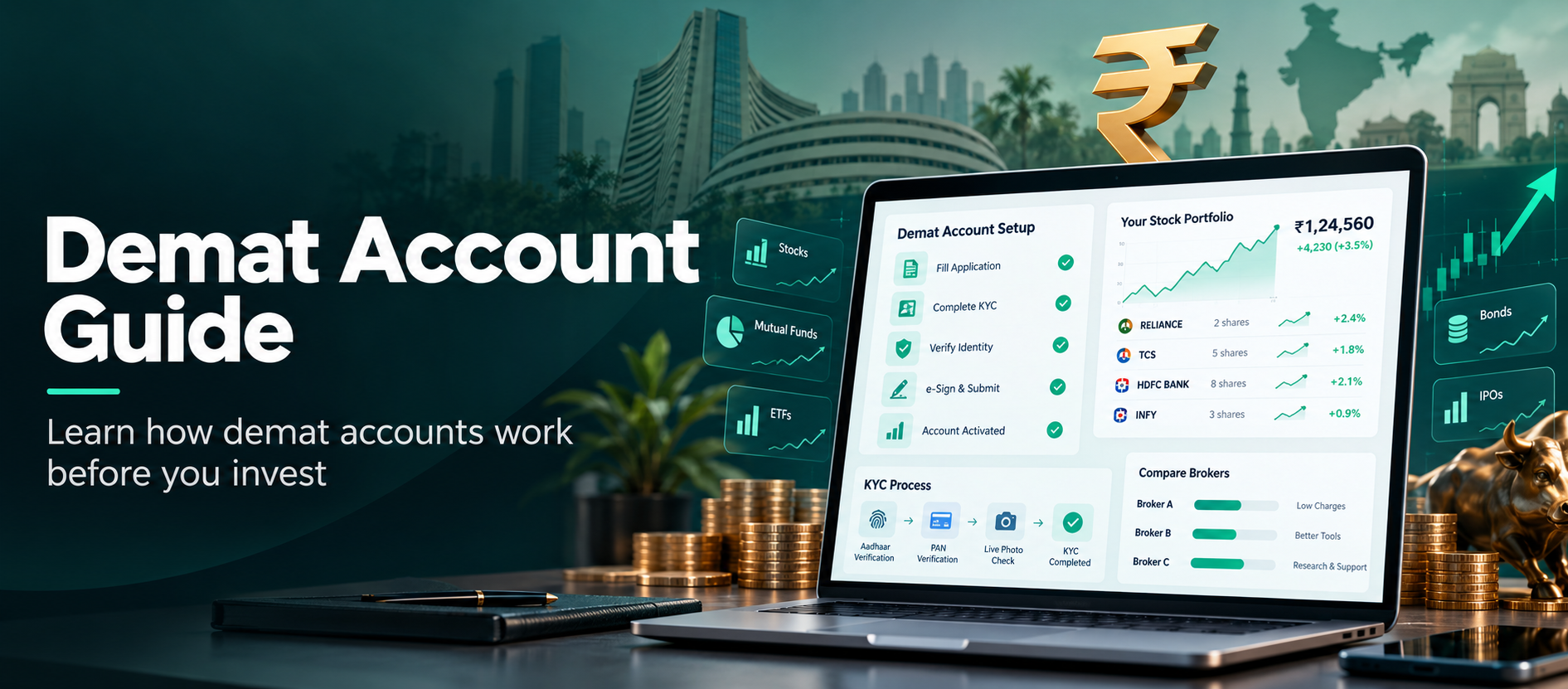
A demat account is one of the first things you need before investing in the Indian stock market. It holds your shares and securities in electronic form, just like a bank account holds your money.
If you want to invest in stocks, ETFs, IPOs, bonds or other market-linked securities, you will usually need a demat account along with a trading account.
This guide explains what a demat account is, how it works, why it is important and how to choose the right broker for opening one.
Important note: Demat account charges, brokerage plans and platform features may change from time to time. Always verify the latest details on the broker’s official website before opening an account.
What Is a Demat Account?
A demat account, also called a dematerialised account, stores your securities in electronic form.
Earlier, shares were held as physical certificates. Today, shares are mostly held digitally through demat accounts. This makes investing safer, faster and easier.
A demat account can hold:
- Equity shares
- ETFs
- Bonds
- Government securities
- Mutual fund units, where applicable
- IPO shares after allotment
- Other eligible securities
When you buy delivery shares, they are credited to your demat account. When you sell those shares, they are debited from your demat account.
Demat Account vs Trading Account
Many beginners get confused between a demat account and a trading account.
A trading account is used to place buy and sell orders in the stock market.
A demat account is used to hold the shares and securities after you buy them.
For example, if you buy shares through brokers like Zerodha, Groww, Angel One, Upstox or ICICI Direct, the order is placed through your trading account. Once the shares are delivered, they are stored in your demat account.
In simple words:
- Trading account = used for transactions
- Demat account = used for holding securities
Why Do You Need a Demat Account?
A demat account is required for holding securities electronically. It makes investing simpler and reduces the risks linked with physical share certificates.
You need a demat account if you want to:
- Buy and hold shares
- Apply for IPOs
- Invest in ETFs
- Hold bonds or other eligible securities
- Sell delivery shares
- Maintain your long-term investment portfolio
For long-term investors, the demat account becomes the central place where holdings are stored and tracked.
Benefits of a Demat Account
A demat account offers several practical benefits.
1. Safe Electronic Holding
Your securities are stored digitally, reducing the risk of physical certificate loss, damage or theft.
2. Easy Buying and Selling
When you buy shares, they are credited electronically. When you sell them, they are debited electronically.
3. Faster Settlement
Modern market settlement systems make share transfers faster and more efficient.
4. Easy Portfolio Tracking
Most brokers provide dashboards where you can track your holdings, profit/loss, transaction history and portfolio value.
5. IPO Investing
A demat account is required for IPO allotment. If shares are allotted, they are credited directly to your demat account.
6. Reduced Paperwork
Once your account is opened, most transactions happen digitally.
Common Demat Account Charges
Before opening a demat account, you should understand the charges involved.
Common charges may include:
- Account opening charges
- Annual maintenance charges
- DP charges
- Pledge and unpledge charges
- Dematerialisation charges, if applicable
- Rematerialisation charges, if applicable
- Statement or physical request charges
- Other account service charges
Not every broker charges the same fees. Some brokers offer zero account opening, some waive AMC for the first year, and some may charge monthly or annual maintenance fees.
What Are DP Charges?
DP charges are charged when shares are debited from your demat account, usually when you sell delivery shares.
Many beginners compare only brokerage and ignore DP charges. But if you frequently sell delivery holdings, DP charges can affect your total cost.
Before opening an account, check the broker’s tariff sheet for DP charges and demat-related fees.
How to Open a Demat Account
Opening a demat account is now mostly online.
The general process includes:
- Choose a broker
- Visit the broker’s official website
- Enter mobile number and email
- Complete PAN and Aadhaar verification
- Complete bank verification
- Upload or confirm required documents
- Complete e-sign or verification process
- Wait for account activation
Brokers like Groww, Zerodha, Angel One, Upstox, Dhan and 5paisa offer digital account-opening processes.
Bank-backed brokers like ICICI Direct, HDFC SKY, Kotak Neo and SBI Securities may be preferred by users who want banking ecosystem convenience.
Documents Required for Demat Account
You may generally need:
- PAN card
- Aadhaar card
- Mobile number linked with Aadhaar
- Bank account details
- Cancelled cheque or bank proof, where required
- Signature proof, where required
- Income proof for derivatives activation, where required
Requirements may vary depending on broker, segment activation and regulatory rules.
Types of Brokers for Demat Account
There are mainly two broad types of brokers: discount brokers and full-service brokers.
Discount Brokers
Discount brokers usually focus on low-cost trading and online platforms. They are suitable for self-directed investors and active traders.
Popular discount brokers include:
Discount brokers may be suitable if you are comfortable making your own investment decisions and want lower trading costs.
Full-Service and Bank-Backed Brokers
Full-service brokers may offer research, advisory, relationship support, branch support and a wider financial-services ecosystem.
Popular full-service or bank-backed brokers include:
These brokers may be suitable if you want research, banking integration or assisted services.
How to Choose the Best Demat Account
There is no single best demat account for every user. The right choice depends on your investing style.
Before opening an account, compare these points:
- Account opening charges
- Demat AMC
- DP charges
- Brokerage charges
- Trading platform quality
- Mobile app experience
- IPO access
- Mutual fund access
- MTF availability
- Research and advisory support
- Customer service quality
- Bank integration
- Ease of fund transfer
- Suitability for beginners or traders
A beginner may prefer simplicity, while an active trader may prefer fast platforms and low charges. A long-term investor may prefer research, portfolio tools and support.
Broker-Wise Suitability
Here is a simple way to understand which broker may suit different users.
Zerodha
Zerodha may suit self-directed investors and active traders who want a strong trading platform and low-cost structure.
Groww
Groww may suit beginners and mobile-first investors who want a simple and clean investing experience.
Angel One
Angel One may suit users who want digital trading along with research and investment ideas.
Upstox
Upstox may suit traders looking for a digital discount broker with access to multiple trading segments.
Dhan
Dhan may suit active traders, TradingView users and users who want modern trading tools.
5paisa
5paisa may suit cost-conscious investors and traders looking for a digital discount broking platform.
ICICI Direct
ICICI Direct may suit users who want banking integration, research and a full-service broking ecosystem.
HDFC SKY
HDFC SKY may suit users who want digital trading, research, MTF and the convenience of the HDFC ecosystem.
Kotak Neo
Kotak Neo may suit Kotak ecosystem users and investors who want a bank-backed trading platform.
Motilal Oswal
Motilal Oswal may suit investors who value research, advisory support and long-term investment ideas.
Demat Account for Beginners
If you are opening your first demat account, focus on simplicity and transparency.
A beginner should check:
- Is the app easy to use?
- Are charges clearly explained?
- Is account opening simple?
- Is customer support available?
- Can I invest in stocks, mutual funds and IPOs?
- Are educational resources available?
For beginners, platforms like Groww, Angel One and Zerodha are commonly considered, depending on whether the user wants simplicity, research or a stronger trading ecosystem.
Demat Account for Active Traders
Active traders should look beyond only demat AMC. They should focus on trading platform speed, order execution, charting, brokerage, F&O charges and risk-management tools.
Traders may compare brokers like Zerodha, Dhan, Upstox, FYERS and 5paisa.
Demat Account for Long-Term Investors
Long-term investors may care more about delivery brokerage, AMC, portfolio tracking, research, IPO access and overall reliability.
They may compare brokers like ICICI Direct, HDFC SKY, Motilal Oswal, Kotak Neo, Groww and Zerodha.
Common Mistakes to Avoid
Avoid these mistakes while opening a demat account:
- Choosing a broker only because of advertisements
- Ignoring AMC and DP charges
- Not checking F&O charges before trading derivatives
- Not reading the tariff sheet
- Ignoring customer support quality
- Not checking platform stability
- Opening multiple accounts without understanding total cost
- Using MTF without understanding risk
A demat account is a long-term financial tool, so choose carefully.
Final Thoughts
A demat account is essential for investing in the Indian stock market. It allows you to hold shares and securities electronically and makes investing more convenient.
The best demat account depends on your needs. If you want simplicity, Groww may be suitable. If you want a strong trading ecosystem, Zerodha and Dhan are worth evaluating. If you want research and banking convenience, ICICI Direct, HDFC SKY, Kotak Neo and Motilal Oswal may be better options.
Compare charges, features, platform quality and suitability before opening an account.
Disclaimer: This guide is for educational and comparison purposes only. It is not investment advice or a recommendation to open an account with any specific broker. Please verify charges, features and account terms directly from the broker’s official website before opening a demat account.